

13.
Published onThe responses to the following information requests were taken into account in determining the assigned category and developing the assessment:
Ministry of Energy
https://drive.google.com/file/d/1R2DVDIEcqLcYp8z66G7UsopAj8QERrDO/view?usp=drive_link
Further information:
Argentina did not explicitly adopt the global target assessed under this indicator. The National Energy Transition Plan includes, as a quantitative target, a reduction of at least 8% in energy demand by 2030 through energy efficiency and responsible energy use. In addition, the National Climate Change Adaptation and Mitigation Plan (2022) presents lines of action containing measures that address this issue.
Table 1: Targets identified in relation to energy efficiency actions under the National Climate Change Adaptation and Mitigation Plan (2022)
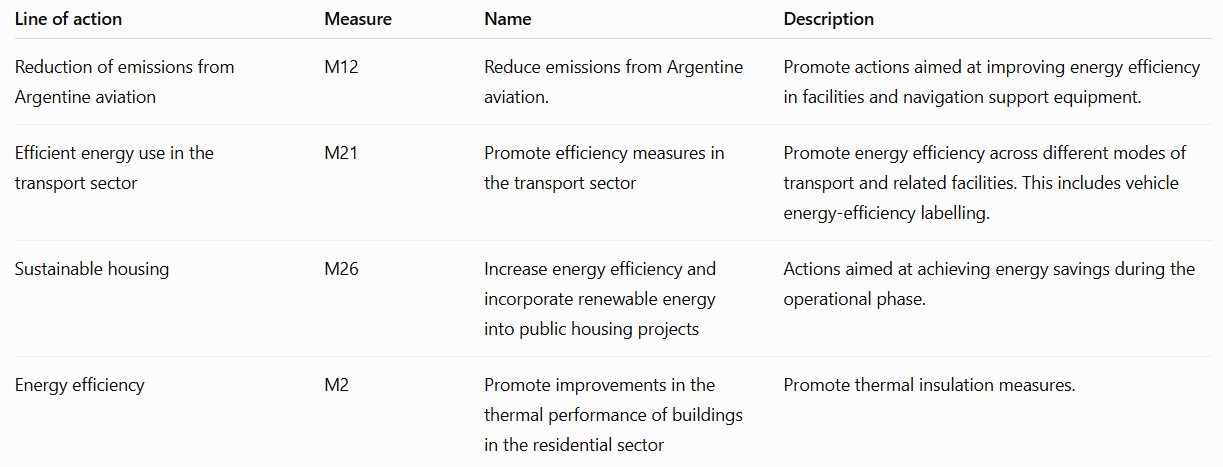
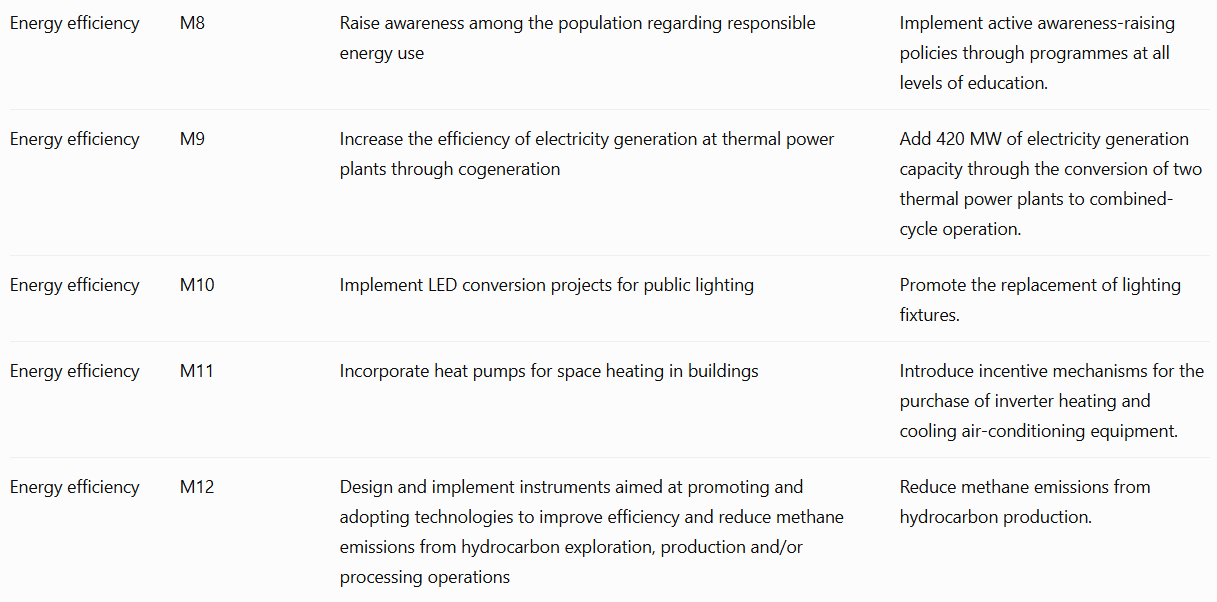
Notwithstanding the details above, the First Progress Report on the Implementation of the Second National Climate Change Adaptation and Mitigation Plan presents the progress made towards achieving these targets. The report does not monitor all the targets identified, nor does it guarantee that progress on these measures will be sufficient to achieve the objective. In the specific case of the target “Sustainable design and process innovation – M8”, although it is reported as completed, the description of the actions undertaken refers to the preparation of a diagnostic document (Progress Report, 2024, p. 111), but does not detail concrete actions that would support the conclusion that the target has been effectively achieved.
In 2018, the Secretariat of Energy worked on a Methodological Guide for the Preparation of a National Energy Efficiency Plan. However, according to the information reviewed, no progress was made towards its implementation. Subsequently, the Argentina Energy Scenarios 2040 initiative, led by the National Secretariat of Energy, projected potential improvements in energy efficiency. However, once again, no monitoring information on the objectives established under that initiative could be accessed.
Regarding the energy intensity of the economy, no significant changes were observed, with the indicator remaining broadly stable according to data from the International Energy Agency.
FIRST ASSESSMENT OF THIS OBJECTIVE CONDUCTED IN AUGUST 2025
Category
No progress
Detail
Although this objective forms part of a global commitment, its achievement depends on coordinated national efforts that take into account each country’s capacities, challenges and circumstances. In Argentina, the energy intensity of the economy, measured in MJ per USD of GDP, remained virtually unchanged between 2012 and 2022, at approximately 4.0 MJ/USD, according to data from the International Energy Agency (IEA). This stagnation can be explained by both the absence of sustained energy-efficiency policies and limited economic growth over the period.
Given the accumulated delay and the absence of a robust regulatory framework in this area, it is highly unlikely that Argentina will be able to double its annual rate of improvement in energy efficiency in line with the global target.